
Creative Branding Techniques for Custom Cosmetic Bags

Personalized Beauty Bag Maker: Custom Cosmetic Cases

By 2025, the worldwide cosmetic bag market will reach $5 billion. Such growth reflects a strong taste for chic, practical beauty-product carriers. As a leading cosmetic bag manufacturer, our goal is to craft bespoke designs that captivate the senses and meet practical needs. We collaborate closely with brands to develop premium, custom cosmetic bag manufacturer embodying each brand’s identity

Essential Insights

  • Market forecasts show $5 billion in cosmetic bag sales by 2025
  • Custom bags for beauty are tailored to meet specific brand and consumer needs
  • Custom beauty bag makers emphasize craftsmanship and aesthetics
  • Working with producers allows brands to define their distinct persona
  • Practicality and style drive cosmetic bag success

What a Cosmetic Bag Manufacturer Does

A cosmetic bag maker plays a vital role in beauty markets. They act as a bridge between product creators and consumers. They craft bespoke bags tailored to brand requirements. They ensure each bag aligns with the brand’s aesthetics and fulfills functional requirements.

In a cutthroat industry, an appealing cosmetic bag is crucial. It serves as a container for beauty products and a marketing tool to draw in customers. A high-quality cosmetic bag boosts the product’s appeal and strengthens the brand’s identity.

cosmetic bag manufacturer

Knowing industry hurdles helps manufacturers innovate effectively. Options span materials, styles, and dimensions. Picking the ideal maker is vital for thriving in a dynamic market.

Types of Custom Bags Offered

Manufacturers supply many bespoke bag types for diverse uses. Custom PVC cosmetic bags stand out for their durability and water resistance. They are perfect for storing liquids and beauty products. And they clean easily for added convenience.

Custom velvet cosmetic bags, on the other hand, bring a touch of elegance and luxury. Velvet’s plush feel lends refined style. This appeals to those who value finer details and seek to improve their brand image.

Knowing the different types of custom bags helps brands make better choices. A well-chosen bag elevates brand presence and satisfies user tastes.

Benefits of Choosing Custom Cosmetic Bags

Tailored beauty bags provide major brand benefits. They enhance brand recognition through logo placement. This makes them powerful marketing tools, leaving a lasting impression on customers.

Custom bag producers craft styles for diverse consumer preferences. Such tailoring allows brands to differentiate themselves. It motivates customers to prefer items matching their tastes and requirements.

Custom bags foster stronger customer loyalty. When customers receive a high-quality, stylish cosmetic bag, it creates a bond with the brand. Such rapport drives repeat business and referrals.

Partnering with a branded bag maker streamlines design and ensures quality. It enables brands to tell their narrative, enhancing marketing and audience engagement.

Custom Bag Material Choices

Material selection defines bag attractiveness and usability. Manufacturers provide a range of material options to meet various consumer needs and market trends. PVC bags stand out for toughness and waterproof qualities, perfect for everyday use.

The velvet cosmetic bag, on the other hand, offers elegance, appealing to a more premium audience. Brands covet velvet for its rich texture and upscale appearance. It’s critical for brands to grasp these material traits to match their packaging with their branding goals.

Knowing PVC’s utility and velvet’s elegance guides brands to optimal decisions. Opting for the right materials can boost customer happiness and loyalty to the brand.

Output Capacity of Top Bag Producer

A leading cosmetic bag manufacturer has an impressive production capacity. They often produce over 90,000 units monthly. This high output allows brands to adjust their orders according to market changes and seasonal trends. Quality remains uncompromised.

These manufacturers operate in facilities of at least 25,000 square meters. They have a team of over 200 skilled employees. This structure guarantees fast production and premium bags adhering to rigorous criteria.

High-volume capability makes them a dependable ally. They help businesses grow their product lines while keeping customer satisfaction high.

OEM & ODM Offerings

OEM and ODM are vital for brands seeking distinctive beauty bags. They enable deep co-creation with makers to fulfill exact designs. OEM services help brands create products that reflect their unique identity while maintaining quality. It fosters creativity and innovation, crucial for standing out.

ODM provides end-to-end design services aligned with trends and market needs. Brands gain access to expert design teams who grasp market dynamics. They bring concepts to life, enhancing product lines and speeding development. This leads to faster market entry and better efficiency.

Opting for OEM/ODM is strategic for boosting beauty brand impact. By adopting these tailored solutions, companies can craft distinctive cosmetic bags that connect with their audience.

Service Type Description Benefits
OEM Services Adapting current designs for brand needs Exclusive branding opportunities, enhanced product quality
ODM Services Complete design and manufacturing solutions Expert design, quicker launch
Tailored Solutions Personalized approaches based on brand vision Unique product differentiation, strong market placement

Ensuring Quality in Bag Making

QA is crucial in PVC cosmetic bag. It guarantees all bags match or exceed industry benchmarks. Manufacturers conduct thorough testing to check durability, material compliance, and aesthetic quality.

When choosing a cosmetic pouch supplier, brands must focus on those with strict quality checks. Early defect detection ensures a final product upholding brand standards. Following production norms is essential to show reliability.

High-quality assurance practices build trust between suppliers, manufacturers, and clients. Commitment to quality yields elegant, functional, long-lasting bags.

Fast Fashion Trends in Cosmetic Bag Manufacturing

The cosmetic bag manufacturing industry has seen a significant shift with the emergence of fast fashion trends. Now, brands demand rapid design-to-production turnaround. Such speed requirements shape bag design and manufacturing.

Market adaptability is key for manufacturers to keep up with changing consumer preferences. Trends can shift rapidly, making it critical for manufacturers to stay ahead. Maintaining a diverse range of styles and designs is vital. It lets brands cater to a wide market seeking fresh beauty gear.

Top bag producers must stay agile. Being agile means satisfying demand and outperforming rivals. Agility is key to thriving in fast-fashion contexts.

Collaborations with Top Brands

Collaborating with well-known brands can greatly improve a cosmetic bag manufacturer’s standing in the market. These partnerships showcase the manufacturer’s capabilities while linking with trusted names. That collaboration yields distinctive products aligned with market demand.

Partnering with renowned brands boosts exposure and market knowledge. Such interaction fosters innovation, compelling makers to evolve. By capitalizing on these branding chances, companies can emerge as leaders in the cosmetic bag industry.

Inside a Custom Bag Factory

Visiting a custom makeup bag factory offers a unique inside look at the detailed manufacturing process. Each phase, from initial design to final assembly, is critical for producing high-quality items. Brands must grasp factory operations when seeking manufacturing partners.

Upon entering, one sees the various stages that shape the bag’s final form. Design and engineering teams collaborate on creative, functional concepts. Once prototypes are approved, cutting, stitching, and QA begin.

Efficiency in production is key to meeting market demands. Manufacturers use advanced technologies and skilled labor to optimize workflows. The focus on quality control ensures every product meets standards before it reaches consumers.

Knowing production workflows guides brands in selecting partners. Exploring a factory’s materials and skills reveals what sets leading makers apart.

How to Choose the Right Cosmetic Pouch Supplier

Choosing the right cosmetic pouch supplier is critical for any beauty brand. A thorough evaluation should consider several key factors for a successful partnership. Start by evaluating their output capability. Ensure they handle your volumes and deadlines.

Material choices are another key factor. Verify they employ premium materials meeting your specs. Superior materials enhance appeal and drive loyalty.

Looking at past velvet cosmetic bag manufacturer samples can reveal a supplier’s craftsmanship and reliability. Reviews and feedback from other clients also shed light on their reputation. Good communication is key for a successful partnership, so evaluate how well suppliers discuss design and timelines.

In summary, making an informed choice requires a detailed evaluation of suppliers’ capabilities, quality, and communication skills.

Key Traits of Top Case Producers

Choosing the right branded cosmetic case producer involves several key considerations. Seek makers boasting excellent history and client praise. This reveals their true competencies. Quality is a must, ensuring the products are not only up to par but also durable.

It’s also vital to evaluate the producer’s design flexibility. Unique designs can make your products stand out in a crowded market. Hence, early branding choices matter greatly. Trustworthy collaborations yield remarkable items, elevating brand recognition and loyalty.

Final Thoughts

Selecting an ideal bag maker is essential for brands seeking to enhance promotion and style. With diverse materials and output scales, brands face multiple considerations. These decisions greatly affect their overall brand image.

Custom bags are more than just containers for makeup; they reflect a brand’s identity and values. Choosing a partner aligned with their goals lets brands craft items resonating with customers. This connection between product and brand is critical for building loyalty and increasing sales.

Selecting a bag maker is a tactical decision, not merely operational. By prioritizing excellence and creativity, brands can strengthen their image. And offer goods that leave enduring impressions.

Common Questions

What bag varieties do makers provide?

Manufacturers offer a wide range of custom bags, including PVC, velvet, and makeup organizers. Each type caters to different needs, from practicality to luxury appeal.

How can custom cosmetic bags benefit my brand?

Bespoke bags raise brand awareness and set you apart. They meet specific consumer preferences, serving as both packaging and marketing tools.

Is bespoke design possible with the maker?

Yes! Many manufacturers provide OEM and ODM services. This allows brands to work closely and create exclusive designs that match their vision.

Which materials can be used for bags?

Manufacturers offer various materials, including durable PVC, elegant velvet, and different fabrics. Each material suits different market segments and customer preferences.

How to pick a cosmetic pouch partner?

Evaluate suppliers based on production capacity, design capabilities, and quality assurance. A proven track record and good reviews ensure trustworthy collaboration.

What output volume do premier bag producers achieve?

Top producers exceed 90 000 bags per month. This allows brands to scale orders effectively based on demand and seasonal trends.

Why is quality assurance important in cosmetic bag manufacturing?

Quality assurance ensures cosmetic bags meet industry standards for durability and aesthetics. Trustworthy makers rigorously test to avoid flaws. This guarantees a product that reflects your brand’s quality commitment.

How do trends influence bag manufacturing?

The rise of fast fashion requires manufacturers to be agile. They must adapt quickly to rapid design changes and meet evolving consumer demands.

Key factors for choosing case manufacturers

When choosing a branded cosmetic case producer, look at their project portfolio, design flexibility, and quality commitment. Collaboration and clear communication are likewise critical.

Controlling Cure Times in Fiber Secondary Coating Lines for Maximum Clarity

Looking Forward: Fiber Optic Data Transfer Technology

Did you know that one hair-thin fiber can transmit more than 100 Tbps of information each second? That capacity could handle streaming 12 million HD films at once—a leap from the 1950s, when researchers began using light for rudimentary signaling.

  • Data transmission rates 100x faster than old copper lines
  • Zero interference from power lines or radio signals
  • Capacity to support 5G networks and 8K streaming
Characteristic Copper Wiring Optical Fibers
Data Rate Up to 10 Gbps Exceeding 100 Tbps
Distance Approximately 100 m Over 70 km
Privacy Prone to tapping Highly resistant to eavesdropping

Optical signals reflect within glass cores via total internal reflection, like a laser ricocheting through a mirrored tunnel. This physics trick prevents signal loss, even over continental distances. With growing video conferencing and IoT devices, these fibers prevent network overloads – fiber secondary coating line.

Evolution of Fiber Optic Communication Technology

Years of research turned the concept of optical data transmission into a working technology. Scientists in the 1950s found glass fibers can channel light—a concept that reshaped modern connectivity.

9F675456 9242 4Fbc 9559 393Ac5C06C2A

Early Experiments and Pioneers

Narinder Singh Kapany made history in 1952 by proving light could travel through bent glass. His work coined the term “fiber optics” and laid the foundation for today’s networks. Together with Harold Hopkins, he created pliable imaging bundles, which became prototypes for data-carrying fibers.

By the 1960s, labs demonstrated practical uses for these strands. Early systems faced challenges like signal loss, but persistent testing refined their design. Researchers found that ultra-purified glass cores extend signal reach with minimal distortion.

Key Fiber Optic Breakthroughs

The 1970s marked a turning point with the first commercial installations. Telephone companies adopted cables that replaced copper lines, boosting call clarity and capacity. In 1970, Corning Glass Works introduced low-attenuation fiber capable of 65 km spans.

Year Achievement Significance
1977 Initial live telephone transmissions Validated practical dependability
1988 Transatlantic cable TAT-8 Linked Europe and North America
1990s Erbium-doped amplifiers Allowed extensive long-haul connections

Today’s innovations prioritize higher throughput and expandability. Dense wavelength-division multiplexing (DWDM) now lets single strands carry multiple data streams simultaneously. Such progress connects laboratory research to worldwide network infrastructures.

Fundamentals of Fiber Optic Communication Technology

Given light’s unmatched speed, it’s a perfect medium for data transmission. This straightforward concept underpins contemporary networks. Instead of slow electrons in copper wires, engineers use photons to zip data across continents. Below is the fundamental mechanism.

Photon-Based vs. Electron-Based Signaling

Light pulses carry information more efficiently than electricity. Photons:

  • Move at 186,000 miles per second (99.7% light speed)
  • Generate no heat or EMI
  • Can carry multiple signals at once using different wavelengths
Factor Electron Signaling (Copper) Photons (Glass)
Data Rate Max ~10 Gbps 100+ Tbps
Noise Susceptibility Affected by power lines Unaffected by EMI
Energy Use High Low

Total Internal Reflection in Fiber Cores

Light stays trapped in the core—the central glass strand—thanks to total internal reflection. The core has a higher refractive index than the surrounding cladding. When light hits the boundary at a steep angle, it bounces back like a mirror, staying on course for miles.

Such a design minimizes attenuation. Over extensive spans, nearly 95% of photons arrive intact. Combined with laser precision, it ensures your video calls stay crisp and your downloads finish fast.

Various Fiber Cable Categories

Fibers come in diverse designs. The right cable type depends on how far your data needs to travel and how much information you’re sending. Let’s break down the two main categories and their specialized designs.

Feature SMF Multi-Mode
Core Diameter ~9 microns 50–62.5 µm
Bandwidth >100 GHz ~35–500 MHz
Maximum Span 120 miles ~1,600 ft
Common Uses Long-haul telephony Local area networks

Hospitals use single-mode for MRI image transfers between buildings. Schools often pick multi-mode for classroom networks—it handles video streams without breaking budgets. Both types keep our world connected, just in different ways.

Anatomy of Fiber Optic Cables

Curious how connectivity persists despite storms? The answer lies in the smart design of modern cables. These high-tech threads use multiple layers to protect data while traveling at light speed.

Core, Cladding & Coating Explained

At the heart of every cable sits the glass core—thinner than a human hair. This pure glass guides photons via total internal reflection. The cladding layer, with a lower refractive index, reflects stray light back into the core.

A protective acrylate coating wraps these layers. This ~250 µm barrier safeguards against physical abrasions and water ingress. Collectively, these layers create the optical conduit for data.

Strengthening Fibers and Protective Jackets

Kevlar® reinforces the coated core, ensuring tensile strength. Aramid strands handle pulling forces to avoid fiber breakage. An outer polyethylene jacket completes the package, resisting weather, chemicals, and curious rodents.

Layer Substance Role
Central Glass Pure silica glass Light transmission
Surrounding Glass Doped silica Signal containment
Coating Acrylate polymer Physical protection
Jacket Polyethylene Environmental shield

Color coding matters too—orange jackets denote multi-mode cables, while yellow marks single-mode versions. Technicians rely on these hues to differentiate fibers for setup or troubleshooting.

How Fiber Carriers Transmit Data

What enables near-light-speed data transfer with minimal loss? It involves converting electrical pulses into controlled optical bursts. Flashes map bits (1s) and dark intervals (0s), forming an optical binary stream deciphered by lasers.

Optical Signaling Mechanics

Lasers emit ~500 million pulses/sec through fiber cores. By using QAM-16, four bits encode per pulse, multiplying throughput – Fiber cable sheathing line. This photon dance happens with near-zero electromagnetic interference, unlike older copper-based systems.

Managing Dispersion & Attenuation

Two primary issues compromise signal integrity:

  • Wavelength dispersion: Different light colors (wavelengths) arrive at varying speeds.
  • Mode dispersion: Light paths scatter in multi-core cables.

Modern cables combat these issues through:

Solution Effect Gain
Doped glass cores Equalizes propagation speeds ~40% reduction in pulse broadening
DSP units On-the-fly error mitigation 99.999% accuracy

High-end fibers reduce attenuation to ~0.15 dB/km, improving by ~92% over initial versions. Combined with anti-interference coatings, these innovations maintain data integrity across continents. Consequently, transoceanic calls remain sharp despite severe weather.

Advanced Concepts in Optical Fiber Networking

How do video streams remain stable amid storms? The answer lies in specialized connectors and precision installation methods that form the backbone of modern networks. Such gear guarantees uninterrupted data transfer regionally and globally.

Connectors and Splicing Techniques

Robust networks begin with correct fiber terminations. SC connectors offer tool-less insertion; LC connectors compress for high-density environments. MPO/MTP designs handle multiple strands at once—perfect for data centers moving massive files.

Splicing primarily uses two approaches:

  • Fusion splicing: Melts glass ends together for near-zero signal loss.
  • Mechanical splicing: Aligns fibers with precision sleeves for quick repairs.
Connector Ideal Use Insertion Loss
SC Commercial infrastructures ~0.25 dB
LC Dense patch panels ~0.20 dB
MPO Data center interconnects 0.35 dB

Contemporary Network Architectures

Modern designs require adaptable deployment methods. Micro-duct systems permit cable blowing; armored jackets resist severe environments. In smart cities, fibers weave through traffic lights and security cameras, creating responsive urban networks.

Telecom operators roll out hybrid assemblies, merging electrical and optical conductors. Such designs feed 5G small cells and IoT sensors alike, showcasing agile network evolution.

High-Speed Data Transmission and Bandwidth Benefits

Think of data as water flowing through pipes—the wider the pipe, the more you can move at once. This bandwidth principle underlies the shift to fiber optics. Where copper struggles like a garden hose, advanced cables act as firehoses, handling thousands of HD streams simultaneously.

  • Photons moving at ~186,000 mi/s
  • Multiple data streams via wavelength multiplexing
  • FEC slashes retransmissions by ~80%
Time Period Max Speed Price per Gigabyte
1980s ~45 Mbps $1,200
2000s 10 Gbps ~\$0.12
2020s 178 Tbps ~\$0.0004

Bandwidth directly impacts what we can do online. Videoconferencing needs 5 Mbps per user, while VR demands 50 Mbps. As NEC’s 2023 report shows, networks using glass cables support 40x more users than copper alternatives at half the energy cost.

“Every dollar invested in high-capacity networks yields $3.80 in economic growth through improved productivity.”| “Each \$1 poured into high-bandwidth infrastructure returns \$3.80 in productivity gains.”

— Tech Market Analytics, 2023

Performance improvements also slash operational costs. Signals travel 60 miles without repeaters versus copper’s 3,000-foot limit. Such efficiency powers 8K UHD, live AI tasks, and uninterrupted cloud sync at modest subscription fees.

Mitigating Noise & Attenuation

Ever tried making a call during a thunderstorm only to hear static Copper wiring falters when EMI spikes. But glass-based systems laugh it off. By leveraging photons rather than electrons, they eliminate interference from electricity or RF sources.

Built-In Noise Cancellation

Unlike metal wires that act like antennas, glass strands don’t conduct electricity. This means they ignore disruptive signals that plague copper networks. A 2023 study found 92% fewer data errors in industrial settings when using light-based systems compared to older methods – fiber ribbone line.

Engineers combat signal loss through three key strategies:

  • High-purity cores minimize photon scattering
  • Accurate laser coupling decreases insertion loss
  • Hydrophobic layers block water infiltration
Metric Copper Glass-Based
Noise Susceptibility Significant Negligible
Attenuation per Mile ~3 dB/mi ~0.2 dB/mi
Service Frequency Monthly checks Annual inspections

“Our factory’s error rates dropped 80% after switching to light-based networks—no more machine downtime from radio interference.”| “After switching to fiber, error rates fell by 80%, eliminating downtime from RF noise.”

— Manufacturing Weekly Case Study

Fiber excels in harsh environments. Subsea installations withstand saltwater corrosion, while desert networks endure sandstorms without signal degradation. Boasting ~99.995% reliability, they power essential infrastructures globally.

Fiber Optics in Telecommunications and Internet Connectivity

What delivers instant streaming from overseas servers? Fiber networks serve as the neural pathways of today’s Internet. They enable streaming, financial transactions, and more, using light to span oceans and landmasses.

Role in Long-Haul and Metro Networks

Transcontinental cables stretch over 750,000 miles under oceans, carrying 99% of global internet traffic. Urban rings use these fibers to connect cell sites and corporate hubs. Optical transmitters modulate light; receivers demodulate at endpoints.

Attribute Copper Networks Fiber Infrastructure
Throughput 1 Gbps ~100 Tbps
Lag ~5 ms per km 0.005 ms/km
Reliability 99.9% ~99.995%

Data Center & Cable Television Uses

Data centers rely on these cables for inter-rack communication, moving petabytes daily. Cable providers deliver 4K content through hybrid fiber-coaxial systems. Verizon’s 2023 upgrade cut buffering complaints by 73% in urban areas.

Three economic benefits drive adoption:

  • Maintenance costs ~60% lower than copper systems
  • Scalability to handle 5G demands
  • Energy consumption ~40% less per data volume

From Manhattan’s financial district to Pacific submarine routes, these communication systems prove that speed and reliability can coexist. As one engineer noted: “You can’t beat light for moving mountains of data.”

Emerging Technologies in Fiber-Optic Applications

What if your internet could handle 8 billion video calls at once. That’s the promise of next-gen innovations reshaping how we move information. Cutting-edge devices and smarter signal methods are pushing networks to new limits.

Advancements in Laser Transmitters and Photodetectors

Modern lasers now fire 200 wavelengths simultaneously—up from just 40 a decade ago. These tiny chips pack 5x more power while using 30% less energy. Paired with graphene-enhanced detectors, they spot faint light signals other devices miss.

Key breakthroughs include:

  • Lasers with narrow linewidths cut optical noise by ~90%
  • Photonics-integrated circuits shrinking hardware size
  • Machine-learning calibration optimizes performance in real time

Coherent Optics & Multiplexing

Coherent optics modulate both phase and amplitude to encode information. Such techniques increase throughput ~16× over basic on-off keying. When combined with wavelength-division multiplexing (WDM), single strands carry 800+ data streams.

Method Wavelengths Capacity
DWDM ~160 ~80 Tbps
OFDM 512 ~120 Tbps
SDM Multi-core ~1 Pbps*

*Under development by NTT, 2023 results

Such approaches mesh with current networks with minimal overhaul. In 2024, Verizon’s coherent deployment doubled bandwidth on existing fiber routes. An engineer remarked: “Repurposing legacy fibers with coherent methods unlocks untapped potential.”

Global Standards and Design Considerations

Ever wondered how your video call stays crystal clear across continents Universal protocols guarantee seamless interoperability across diverse systems. Without these guidelines, networks would struggle with compatibility issues and performance gaps.

Specification Focus Area Benefit
ITU G.652 Single-mode fiber Enables 100Gbps+ speeds
IEC 60793-2-50 Mechanical reliability Ensures 20-year lifespans
ITU G.654 Undersea fiber Enhances marine durability

Performance Metrics and Quality Assurance

Rigorous validation ensures reliable operations. Primary metrics: attenuation (<0.25 dB/km) and tensile rating (>50 N). Vendors conduct over 200 quality tests, including thermal and bend stress trials.

“Our compliance with IEC 61300-3-35 reduced installation errors by 65% last year.”| “Adhering to IEC 61300-3-35 led to a 65% drop in deployment mistakes.”

— Network Solutions Quarterly Report

Certified parts and precise specs avert expensive rework. Technicians rely on uniform color schemes and termination practices to link heterogenous gear flawlessly. This harmony keeps global data flowing without hiccups.

Real-World Fiber Deployment Examples

How do cities handle millions of simultaneous video streams without crashing Real-world deployments show how smart planning and advanced cables keep our digital world running smoothly. Below are two landmark implementations that transformed worldwide networking.

City Fiber Rollouts & Metropolitan Backbones

New York City’s Metro Fiber project tackled a major challenge: aging copper lines causing 40% slower speeds in business districts. Engineers installed 800 miles of micro-trenched cables under sidewalks, avoiding subway tunnels and gas lines. The result? Latency dropped from 14ms to 2ms, while download speeds jumped 600%.

Issue Approach Result
Subsoil crowding 3D mapping for route optimization 92% faster installation
Signal interference Armored MC fiber ~99.99% reliability
Funding limits PPP funding model ~30% fewer expenses

Subsea and Transcontinental Examples

The MAREA cable—stretching 4,000 miles between Virginia and Spain—handles 160 Tbps across eight fiber pairs. Installation crews faced 10,000-foot depths and shark bites, using robotic subs to bury strands in seabed sediment. Costing \$160M, it transmits ~55% of transatlantic data.

“Subsea systems require 200+ design revisions before deployment. Every meter matters when you’re laying cable across tectonic plates.”| “Over 200 design iterations are typical for undersea cables. Small changes hugely impact viability across plates.”

— Global Connectivity Report 2023

Differences by deployment scenario:

  • Urban projects use bend-resistant cables for tight corners
  • Marine deployments need titanium-armored jackets
  • Isolated sites rely on solar-driven amplifier stations

Both approaches prove that strategic design and durable materials can transform how we move data. From Manhattan’s skyscrapers to Atlantic ocean floors, these networks form the silent backbone of modern life.

Economic Impact and Scalability of Fiber Networks

What powers the streaming revolution and remote work boom It’s networks that pair CAPEX with OPEX efficiencies. Though \$60K/mi can be spent on installation, these fibers pay off over years of use.

Smart Spending for Future Growth

Modern fiber nets reduce OPEX by ~40% versus copper. Fewer repairs are needed—no more corrosion issues or EMI troubleshooting. A 2024 study showed:

Cost Factor Legacy Systems Modern Networks
Deployment ~\$45/m \$28/meter
Power Consumption ~5 W/device ~1.2 W/device
Service Calls ~12 annually ~2 annually

Worldwide spending reflects this transition. Major carriers will invest ~\$150B by 2027 to grow fiber footprints. Urban projects now achieve 300% ROI within five years through increased productivity and reduced downtime.

Overcoming Rollout Challenges

Yet municipalities encounter three primary obstacles:

  • Permit processes can extend schedules by ~18 months
  • Scarcity of skilled fiber technicians
  • Community pushback against trenching

“Our Phoenix deployment took 22 months instead of 14 due to permit bottlenecks. Still, the network boosted local GDP by \$380 million annually.”| “Phoenix’s build required ~22 months, not 14, over permit delays—but delivered ~\$380M/year in GDP uplift.”

— Western Regional Infrastructure Report

Innovative solutions are emerging. Micro-trenches cut surface impact by ~80%; PPP models distribute funding risks. These approaches help communities harness the power of scalable, future-ready systems without breaking budgets.

Innovations and Future Prospects in Data Transmission

Data highways are getting a turbocharged makeover. Researchers now push boundaries with materials thinner than spider silk and signaling methods that outpace traditional designs. These leaps promise to shrink global delays while handling tomorrow’s data avalanches.

Upcoming Fiber Innovations

MIT’s 2024 experiments suggest hollow-core fibers (air-filled) may cut latency ~30%. These tubes guide light through vacuum-like channels, reducing signal drag. Parallel multi-core fibers embed seven channels in one sheath, boosting throughput ~4×.

Metric Current Tech Future Projection
Throughput 100 Tbps ~1.2 Pbps
Range 70 km ~150 km
Power Demand ~0.5 W/device 0.15 W/device

New multiplexing schemes squeeze 400 wavelengths into single strands—up from 160 today. This spectral densification enables 8K VR without congestion.

Convergence with 5G/6G Networks

Future 6G deployments depend on high-capacity fiber rooftails for mmWave support. Dallas field tests achieved ~10 Gbps wireless throughput over robust fiber backhaul.

  • Small cell sites in 5G require fiber connections ~500 ft apart
  • Ground-satellite nodes depend on ultra-low-latency backbones
  • Smart factories use real-time data flows for robotic precision

Nokia’s 2023 report says advanced fiber cuts 5G round-trip delay by ~82%. As one engineer noted: “Wireless needs wired bones—the faster the backbone, the smoother the airwaves.”

The Bottom Line

The invisible threads connecting our digital world keep getting stronger. Over decades, advancements in materials and engineering transformed how we exchange information—from copper’s limitations to light-speed possibilities. Today’s networks prove faster isn’t just better—it’s essential for streaming, surgeries, and stock markets alike.

Modern systems thrive through smart design. Plastic-based protective layers shield delicate glass cores, while global standards ensure seamless compatibility. Such features cut power consumption ~40% versus legacy tech, rendering ultrafast access eco-friendly and expandable.

Challenges remain, like installation costs and public awareness. Yet economic benefits outweigh hurdles—every $1 invested yields nearly $4 in growth. As 5G expands and AI demands real-time data, reliable infrastructure becomes non-negotiable.

Future endeavors will extend these frontiers. Hollow cores and advanced wavelength methods may render current rates outdated. One thing’s clear: the way we share knowledge will keep evolving, driven by humanity’s endless quest to connect faster, farther, and smarter.

Related: Innovations In Temperature Control For Fiber Secondary Coating Line

Why Houston Engineers Prefer Local 5-Axis Machining Services

Houston CNC Lathe Machining Specialists – Custom Parts

What is required to craft accurate components with swiftness and reliability? Distinctive Manufacturing Group shines as a leading provider of state-of-the-art manufacturing services in the region. Serving areas like Downtown Houston, Sugar Land, and Pearland, they specialize in high-quality custom components.

With capabilities spanning multiaxis operations and three-dimensional printing, they process challenging tasks with ease. Expertise in substances such as titanium and high-grade steel guarantees robustness for industrial applications. Their standards-certified operations and immediate estimates make them a proven partner for manual machining services Houston businesses.

Major Takeaways

  • Leading provider for tailor-made processing in the Greater Houston region
  • Capabilities feature five-axis machining and rapid prototyping
  • Works with high-strength materials like titanium and Inconel
  • Delivers rapid delivery with same-day quotes
  • Standards-accredited for quality assurance

Exact CNC Lathe Machining Services in Greater Houston

From fluid power components to spacecraft elements, specialized tools ensure precision. Distinctive Manufacturing Group supplies tailored solutions for sectors demanding centrically machined elements with tight tolerances.

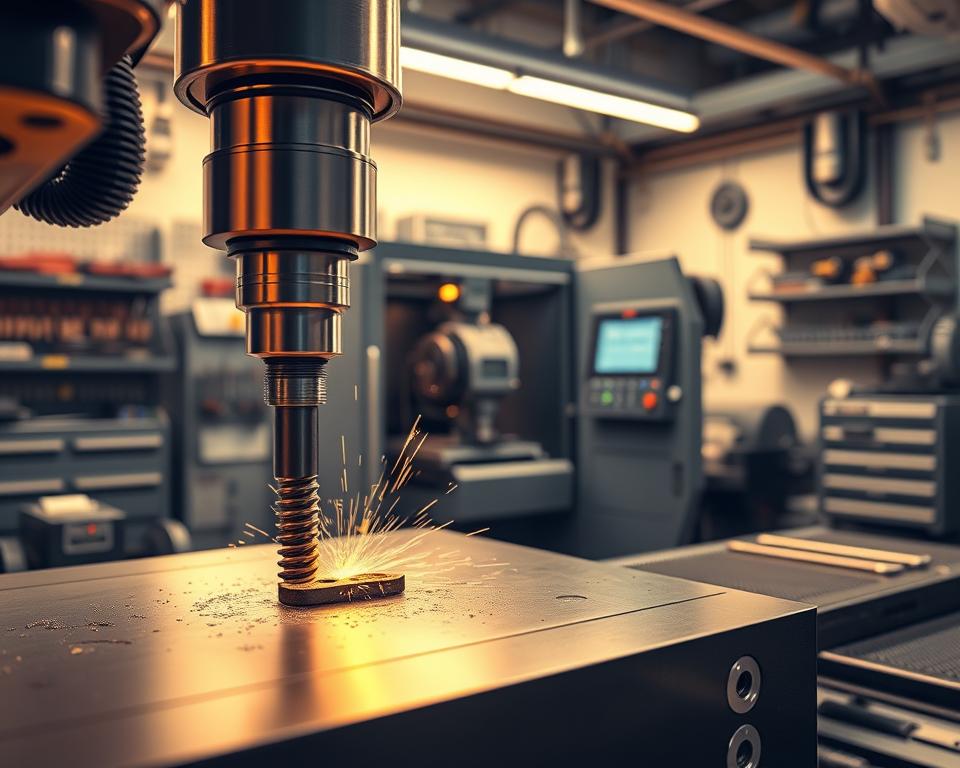
Their lathe machining covers facing, threading, and grooving operations. Featuring capacities of 31 inches in diameter and 30 feet in length, they manage high-volume assignments effortlessly.

Metals including brass, copper-based alloys, and tool steel are processed daily. For aerospace applications, Inconel 718 is processed with precision, ensuring durability under extreme conditions.

Substance Frequent Uses Tolerance (±)
Yellow Metal Piping and wiring 0.005 inch
High-Temp Alloy Airframe and turbine systems 0.001 inch
Tool Steel Tooling and dies 0.003 inch

Secondary operations like thread measuring and API threading refine parts further. Every component undergoes CMM validation, guaranteeing ±0.001″ precision.

Clients rely on these machining services for reliability and speed. From initial prototypes to mass production, accuracy remains paramount.

Why Opt for Our Houston CNC Lathe Solutions?

For scenarios demanding exactness and quick turnaround, the right partner is essential. Our clientele appreciates our ability to deliver customized work, meeting deadlines while ensuring high standards.

State-of-the-Art Tools and Machinery

State-of-the-art tools guarantee exactness for challenging tasks. Operating 20 hours each day, rush projects are finished promptly.

Experienced Machinists

Experienced craftsmen process metals including Inconel and titanium. Their proficiency ensures consistent results, even for parts requiring narrow tolerances.

Quick Delivery

Accelerated production cycles and a rapid quotation process streamline workflows. A live tracking system provides clients with up-to-date project status.

  • Continuous service for time-sensitive projects
  • On-demand stock control minimizes material waste
  • Focused delivery services for all Texas shipments

Streamlined operations underpin all tasks, ensuring reliability from prototype to full-scale production.

Cnc3

What Our CNC Machining Can Do

Today’s fabrication necessitates adaptive strategies for challenging tasks. From intricate geometries to high-volume runs, advanced techniques guarantee exact accuracy and productivity.

Turning Operations

Rotational parts require exacting standards. Processes including facing, thread machining, and grooving achieve tolerances of ±0.001″. Materials like brass and Inconel are machined for durability.

Multi-Axis Milling

Multi-axis tools create flat or contoured surfaces. This method is ideal for sculpting complex cavities, especially in tool steel and aluminum applications.

“Accuracy is more than numbers—it’s repeatability under production pressures.”

Multidimensional 5-Axis Processing

Using 5-axis methods cuts down on configuration time for complex aerospace elements. Such techniques process multi-directional cuts beyond the capability of conventional equipment.

Design Prototyping and 3D Printing

Expedited prototype development validates design concepts rapidly. Stereolithography builds precise medical models, and FDM aids in functional trialing. For metal parts, DMLS offers robust 3D printing solutions.

  • Polyurethane casting for small runs
  • GD&T-compliant inspections
  • DFM feedback via CMM reports

Industries Benefitting from Our Services

Demanding industries seek exactly machined components for dependable operation. Distinctive Manufacturing Group delivers tailored solutions for industries where durability and accuracy are non-negotiable.

Aviation

Critical components demand tight tolerances and exotic materials. Ranging from engine parts to landing structures, pieces are built to resist high stress and temperature variations.

Oil and Gas

Durable valves, drill bits, and pipelines endure harsh environments. Large-scale fabrication supports continuous energy production with minimal interruptions.

Sector Key Components Material Examples
Aerospace Engine supports and fluid systems Inconel, titanium
Oil & Gas Valve bodies, drill collars High-grade stainless steels and advanced duplex alloys
Security Armor plating, radar systems Ballistic-grade steel, composites

“In defense projects, efficiency isn’t optional—it’s mission-critical.”

Defense Sector

Custom elements are fabricated for maximum durability in hostile environments. Tailor-made defense parts and armor pieces are designed to fulfill strict military standards quickly.

Surgical & Implant Solutions

Medical instruments and implant parts rely on safe, biocompatible substances. Prototyping ensures FDA compliance before full-scale production.

Motor Vehicle

EV battery trays and suspension parts prioritize lightweight durability. Mass-produced brake components adhere to strict automotive criteria.

  • High-precision, 5-axis engine components
  • Rapid prototyping for electric vehicles
  • API-certified transmission parts

Our Fabrication Materials

Robustness begins by selecting superior materials for production. Distinctive Manufacturing Group selects high-grade metals, durable plastics, and engineered alloys tailored to tackle rigorous applications. Each material offers unique properties, ensuring optimal performance for specialized applications.

Metals

Metals such as aluminum, corrosion-resistant steel, and titanium serve as the foundation for durable components. These metals balance lightweight design with corrosion resistance, ideal for aerospace and automotive uses. They are processed with precise tolerances and can be formed into intricate shapes.

  • Aluminum: Combines lightness and durability for various structures
  • Stainless steel: Offers corrosion resistance and strength
  • Titanium: High strength-to-weight ratio for critical aerospace parts

Plastics

Polymers like Nylon, Delrin, and PVC excel in diverse, non-metal applications. These materials excel in electrical insulation and low-friction environments. Healthcare tools rely on safe, precise plastics.

  • Nylon: Durable and resistant to abrasion
  • Delrin: Ideal for precision components with stable dimensions
  • PVC: Suitable for harsh chemical environments in pipework

Specialty Alloys

Inconel, brass, and copper alloys handle extreme conditions. Inconel 718 is often chosen for turbine blades because of its exceptional heat resilience. Brass components are precision machined for use in maritime environments.

  • Superalloy parts for elevated temperature aerospace applications
  • Beryllium copper springs for conductivity and strength
  • Monel parts built to withstand marine environments

“Material science isn’t just about composition—it’s about performance under stress.”

Quality Assurance and Precision

Consistency in quality separates exceptional fabrication from average production. Distinctive Manufacturing Group ensures each component meets rigorous standards through advanced verification methods.

CMM Verification Techniques

CMM technology ensures measurements with a tolerance of ±0.001″. Each component is inspected via CMM against its digital twin. These checks eradicate errors before parts are dispatched.

Tight-Tolerance Fabrication

Tight tolerances demand expertise. Materials like Inconel and titanium are machined with precision tools, ensuring repeatability. Thread measuring and API threading refine critical aerospace and oilfield components.

ISO Certification and Compliance

Certifications such as ISO 9001:2015 and NADCAP affirm our quality commitment. Our comprehensive quality management system monitors materials from acquisition to delivery. Regular supplier reviews and traceability measures maintain high standards.

  • Ongoing improvement initiatives drive annual process refinements
  • Immediate measurement data adheres to GD&T criteria
  • Detailed records facilitate audit compliance

From prototype validation to full-scale runs, quality assurance is embedded in every step. Clients receive parts that exceed industry benchmarks—every time.

Personalized CNC Processing Solutions

Tailored fabrication meets unique industrial demands with precision. From prototyping to full-scale runs, every component is engineered to exact specifications. All-in-one solutions streamline the production process and minimize logistical challenges.

Design for Manufacturing (DFM) support optimizes part functionality and cost-efficiency. Our engineers jointly improve design, select the best materials, and optimize tolerances. Early design feedback reduces costly revisions and shortens development time.

For niche projects, reverse engineering revitalizes legacy parts. Advanced scanning captures intricate details, ensuring accurate reproductions. Both bespoke, small-scale orders and large production cycles receive meticulous care.

Additional offerings such as assembly and packing simplify logistics. Advanced coatings and treatments, such as anodizing and powder coating, boost product durability. Every process is tailored to the demands of industries from aerospace to healthcare.

“Real custom fabrication addresses unseen challenges—it’s about solving unseen challenges before they arise.”

Affordable Pricing with Instant Quotations

Smart budgeting meets precision in fabrication services. Distinctive Manufacturing Group combines cost-efficiency with rigorous quality standards, ensuring projects stay on track financially. Rapid quotes and quick pricing adjustments support time-sensitive projects. Our digital system streamlines quote requests, providing real-time clarity for competitive pricing.

Volume discounts reward large orders, reducing per-unit costs, while should-cost analysis reports break down material and labor expenses. This helps clients optimize their budget without sacrificing quality.

“Speed in quoting isn’t just convenience—it’s a strategic advantage for lean operations.”

Collaborative design meetings adjust part details to cut costs. Comprehensive cost analyses show enduring savings throughout production. Every quote reflects value, not just price.

Our CNC Machining Center in Houston

Being local makes a difference when speed and quality count. We support clients all over Houston and beyond—from Pasadena to The Woodlands—with direct, interactive service.

Walk-in consultations allow clients to discuss projects face-to-face. Facility visits reveal state-of-the-art machinery and methods, building trust. For urgent needs, emergency on-site services minimize downtime.

“Choosing a nearby collaborator is more than mere convenience—it’s a strategic asset for rapid response.”

Regional sourcing accelerates material availability, ensuring state-level distribution remains prompt and cost-effective.

Collaborations with local enterprises underline their community focus. From small projects to complete manufacturing, our facility ensures dependable service locally.

The Final Word

Exact manufacturing flourishes with skilled practice and local access. Our team provides accredited, continuous services ideal for defense and healthcare sectors.

We offer complimentary design reviews to enhance project outcomes. Get in touch via phone, email, or web form to receive prompt service.

Our offerings cover the entire state of Texas with reliable partner support. Across every phase, from concept to complete run, reliability is assured.